The variety of the Ligurian environment is to be seen in the large number of nature reserves situated throughout the region: parks and protected areas cover 12% of the territory. The 16 current protected areas, to which the Ligurian Alta Via has to be added, will soon be increased by others now being planned: the new forms of nature tourism, together with the study and increase of environmental knowledge will lead to a greater appreciation of the unique characteristics of an ecosystem that has found a delicate balance in the brusque transition from the coastal area to the mountains.
The international success of the Ligurian Riviera was assured in the nineteenth century, when many foreigners (especially the English) were bewitched by the climate, the sea and the natural environment, began a tourist flow that eventually took the traditional uses of the coastal territory away from fishermen and handicraft workshops.
Elba
Elba is situated about six miles from the mainland. It is in the province of Livorno and is linked to the mainland by an excellent ferry service that runs between Piombino and Portoferraio, the island's main town. Its most famous resident was Napoleon, who spent several months there in 1814-15. Nowadays it is a well-established resort and its beaches are crowded with tourists during the summer months. It has a variety of natural attractions - from the white beaches on the west coast which are ideal for water sports, to the wilder, less accessible beaches on the east with their steep cliffs and rocks, from which rises the little town of Porto Azzurro. Other well-known resorts include Marciana Marina, Rio Marina and the medieval village of Marciana Alta.
Considering its size, the Elba coastline is remarkably developed, with 147 km of coast, over 70 well-known beaches and a host of little bays, inlets and tiny beaches. Altogether, the beaches cover a distance of 17,126 metres, of which 7,908 metres are sand, 3,510 shingle and 5,708 mixed.
The archipelago of Tuscany is the largest marine park of Italy. The great variety of sea-floors and coastlines present in the archipelago determine its characterising biological diversities. The sandy floors are covered with extremely beautiful marine ‘forests'; the coral areas, meanwhile, are real centres for a condensation of marine life. The seas of the archipelago and the Island of Elba are inhabited by innumerable species, including lobsters, morays, groupers, dentex fish, bass, gilthead, etc. More difficult to spot, but nevertheless widespread, swordfish, moonfish, dolphins "Delphinus delphis" and the bottle-noses "Tursiops truncatus", which can be seen off the coast of the islands. Here also it is possible to see, especially in Spring and in Autumn, razorbacks (Balenoptera physalis) and sperm-whales (Physeter macrocephalus). The Aquarium of Elba, at Marina di Campo (3 km from the Laconella campsite), houses approximately 150 different species of Mediterranean sea life.
This small mountainous island remains one of Italy's best kept secrets. An hour's ferry ride from the mainland, and with only a tiny local airport unsuitable for jets, mass international tourism has never gained a foothold and is unlikely to do so. Portoferraio is the main town and principal point of entry, with a fortified old town occupying a small headland that guards the harbour. With a small waterfront lined with commercial buildings and some bars, the town is predominantly residential. The principal tourist haunts have developed around the small seaside villages of Procchio and Marciana Marina on the north coast and Marina di Campo in the south.
Shopping:
Each village has its own handful of unsophisticated tourist-orientated merchandise, with purveyors of fine jewellery and designer fashions remaining on the mainland.
Beach:
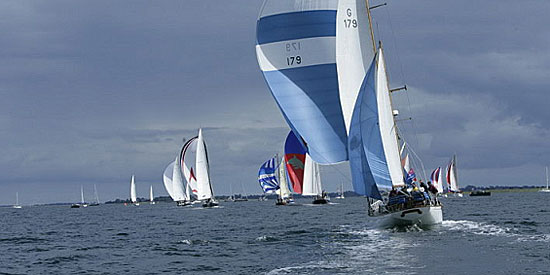
The verdant coastline is littered with small, picturesque rocky coves and some fine sandy bays nestling beneath rugged hills. Some properties have their own reserved sections that are scrupulously maintained and furnished with ranks of sun loungers, deck chairs and colourful parasols. Varied water sports include windsurfing, sailing and water-skiing depending on where you are based.
Entertainment:
Daytime: beach and various water-sports. Numerous hilltop fortifications and several ancient villas purporting to have been Napoleon's former residence during his year-long exile. Nightlife: generally low-key except during July & August. One or two nightspots and bars are open until the small hours in the principal villages, but be prepared to rely on motorised transport if staying at outlying hotels.
Eating out:
Each village has its own complement of unsophisticated restaurants, pizzerias and trattorias. Seafood is abundant as are various forms of locally-made pasta.
Public transport:
Hourly buses serve the principal towns of Portoferraio, Procchio, Marciana Marina and Marina di Campo, although taxis are more convenient for evening journeys in search of entertainment. Regular daily ferries and hydrofoils cross principally between Portoferraio and Piombino. Small local airport for light aircraft.
Local excursions:
Various boat trips around the coast and to uninspiring mainland port of Piombino. Choice of historic hillside fortifications, ancient churches and Napoleonic residences such a Palazzina de Mulini and Villa di San Martino.
CORSICA
The richness of the corsican landscape makes every attempt to describe very difficult, because there are so many various splendours which come close together or become intermingled between marine blue sky and heavenly horizon ; such as the lofty peaks, valleys worthy of a legend, wild or harmonous gulfs, sheltered inlets, placid or wild beaches, cliffs sculpted by men and spindrift, hillsides cut out for vines and the olive tree.
Situated at the junction of the maritime roads leading from France to Italy and the East, and from Central Europe to Italy and Spain, Corsica with 8772 km2, 183 km long and 83 km wide and 1000 km of coasts, is the third largest isle of the Western Mediterranean and the highest too because it reaches its highest point at an altitude at 2710 km!
Corsica is easy to enjoy on a short holiday, but deep appreciation is more hazardous. Travel is counted in time, not in distance. It is said that the Greeks called the island Kalliste and for good reason. It is an island of beauty. That story gives Corsica its constancy.
Bonaparte neglected Corsica during his years of power, but he yearned for the smell of the maquis, when exiled to St Helena. This scent is indeed a special way of recognising you are on the island.
Corsica is a mountain in the Mediterranean - the liquid continent. The granite heights define its outline and also determine much of the character of the people. The island's history has involved most of the countries on the shores of the Mediterranean, but it remains quite unlike any of them.
Corsica may conjure up bandits. But they were bandits of honour. Corsica may invoke the idea of vendetta. But in Corsica, it was not simple revenge. It was a way of keeping the unwritten law.
Corsica's rugged coasts and jagged mountains can be daunting, while its taciturn people may appear unapproachable. Corsicans are intimate in community and personally reserved. Men and women have a striking mutualism. Each is supreme, but not dominant. The family and the clan are paramount, while strangers are welcome.
Much of the mid-level mountains of Corsica are covered in maquis - harsh and resilient bushes like broom, gorse, juniper, laurel, lentisk and myrtle, with the strong and gentle smelling plants like asphodel, cistus, heather, lavender, thyme and sage. This scrub is mythically remembered as the hiding place of the wartime resistance.
The Mountains:
Corsica is mountainous and its highest point is Monte Cintu at 2710 metres. It has twenty other mountains of over two thousand metres and the average altitude is 560m. Corsica has the highest mountains and the most rivers of any Mediterranean island. The mountains run roughly north west to south east and cut the island in two. The east was traditionally known as 'over here' [en deçà des monts, or in Corsican, da monte in qua] or the 'land of the commons' and the west as 'over there' [au delà des monts, or in Corsican, da monte indà] or 'the land of the lords'. There was indeed, no carriage road between the two main towns of Bastia in the north and Ajaccio in the south before the C19. A recent anthropological study shows a certain genetic differentiation between north and south, which follows the linguistic subdivision differentiation. This is quite apart from the differentiation from the populations of France and Tuscany, which have had such political and cultural influences on Corsica .
The Coast:
The coastline of Corsica is 1000 kilometres long [20% of France's coast] and has amazing cliffs, long sandy beaches and many hidden coves. It is almost certainly the least 'spoiled' coastline of France.
There's wonderful walking on coastal paths as well as in the mountains and often in the winter, it may be more advisable to tackle them than risking the heights. One of the finest is round the top of Cap Corse. You can set off from Macinaggio on the east coast and head for the charming small port of Barcaggio [try the Hotel la Giraglia - I've not stayed there]. There's lots to see en route, not least four Genoese towers and great views of Elba.
The French Coast Law [loi littoral] has come too late to save the Riviera, but is stoutly defended in Corsica, though there have been some infringements. The law is designed to permit free access to the sea for all. The coast is defined by all land that is touched by the sea, including in storms. Free access over land should be available within 500 metres of any point and there should be free longditudinal access by foot round the entire coast. The law also protects 'sensitive areas' such as dunes, lagoons, wetlands, woody coastal zones or those which are habitats of protected species. It also has an objective of organised urbanisation, such that the principles of the law are respected. There are sadly some exception, largely for properties constructed before the law came into force; an example is a striking English villa near St Florent, built by Lord Chilcot in the thirties, with its own port and jetty.
As on land, there are a growing number of reserves on the coast. Indeed all the waters of Corsica are a protected area for dolphins and whales. The Bouches de Bonifacio are now a controlled zone and the Gulf of Girolata is a nature reserve, not least to protect the native osprey. Sea horses and cowrie shells are protected species and fishing is forbidden in Corsica coastal waters since October 2002.
PORTOFINO
Coming from the sea, all of a sudden, Portofino is encountered encircled by a hidden bay. The town appears as a "a small village,…, surrounded by a wood of strong and fresh green…", as Guy de Maupassant wrote when he arrived there in 1889.
Its origins go far back in time. It is still not certain whether Portofino was founded by the Phoenicians, the Greek, the Roman or by earlier inhabitants. This place was a natural shelter against wind and sea, favourable to the settlement of man since ancient times.
Portus Delphini, or better the port of the dolphins, so called by Pliny in the third book of Naturalis Historia, is a simple fishing village, with narrow coloured houses, closely built one to the other, crossed by many roads, that lead to the well-known square of polished pebbles already famous in the whole world. Here, high society and nature blend together: the Portofino shelter for VIPs, crossing of famous people and the Portofino of the Park and of the Natural Protected Area with its paths, the Mediterranean scrub, the deep seabed.
The unspoilt nature binds with a very particular maritime village. Here it is possible to go around in the small port just to look at the luxury boats, and maybe meet movie stars; it is possible to choose between a walk up to the lighthouse, walking along the road at the far right of the main square and a visit to the Church of San Giorgio that can be reached through the steep steps of the Umberto wharf that lead to its square.
A ferry ride to the Abbey of San Fruttuoso, masterpiece of the medieval architecture, can be preferred to a tour among the aristocratic villas, hidden in the olive groves, where since the '50s the important personalities of newspapers and magazines live. In any case, Portofino is a magical and fascinating place whose visit reveals different aspects, always charming, to discover and admire in all the different shades.
This famous tourist resort, a long-time favourite of the international jet set, rises on the most southerly point of the homnymous headland, between Camogli and Santa Margherita Ligure, on the Riviera di Levante. Portus Delphini was already know as a safe landing place in ancient times. After being ruled by the abbey of San Fruttuoso, it was handed over to the Genoese. At the end of the 19th c., it was already a favoured holiday spot for the international nobility and bourgeoisie who built villas and parks on the slopes facing the village. Its historic centre, still reasonably intact despite being given over to tourism, looks out onto the famous harbour.
There's no escaping the beauty of PORTOFINO, tucked into a protected inlet surrounded by lush cypress- and olive-clad slopes, yet it manages to be both attractive and off-putting at the same time. This picture-pretty village has been effortlessly drawing in Europe's jetset royals, film stars and other glitterati since the dolce vita days of Bogart and Bacall, Sophia Loren, Burton and Taylor, and Princess Grace, all of whom holidayed here - its snob rating remains impeccable. The village lies at the end of a narrow and treacherously winding road 5km south from Santa Margherita, but thanks to continuous traffic the bus journey can take longer than the boats that shuttle regularly to and from all nearby ports. Once you've arrived and surveyed the expensive restaurants and lace shops by the water, there's not much to do other than watch everyone else do the same.
Portofino is known for being Italy's most picturesque and romantic village. Like the postcard photos it's famous for, Portofino seems to be frozen in time with its pastel fisherman houses lining the winding streets. Forget the glitzy hotels and the plastic storefronts, Portofino is the old Italian Riviera at its best.
Up in the hills surrounding Portofino is the Hotel Splendido, one of the most luxurious and prestigious hotels in the area. Set on top of a hilltop overlooking the harbor, Hotel Splendido has served as a playground and trysting place for the rich and famous. From the British aristocracy at the turn of the century to Hollywood-types after World War II. The public rooms at Splendido boast signed photographs of many of yesterday's movie stars.
The lifestyle is mellow, hang out on the beach, go for a sail or a cruise on your yacht, and take some time to enjoy the local cuisine and wines. Restaurants and bistros dot the streets offering excellent fare for visitors. Take a stroll up to the church San Giorgio for a spectacular view of the harbor. For the more industrious, there are many nearby opportunities for exploring: olive orchards, vineyards, isolated fishing villages, and be sure to walk the spectacular cliffside path to the isolated abbey of St. Fruttuoso, just outside of Portofino.